
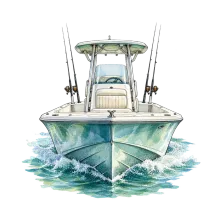
Real-life boats
Types of boats
What every boat in the book really is, what it is for, and what it can’t do. The kind of thing Dan would tell you on the dock before you ever stepped aboard.
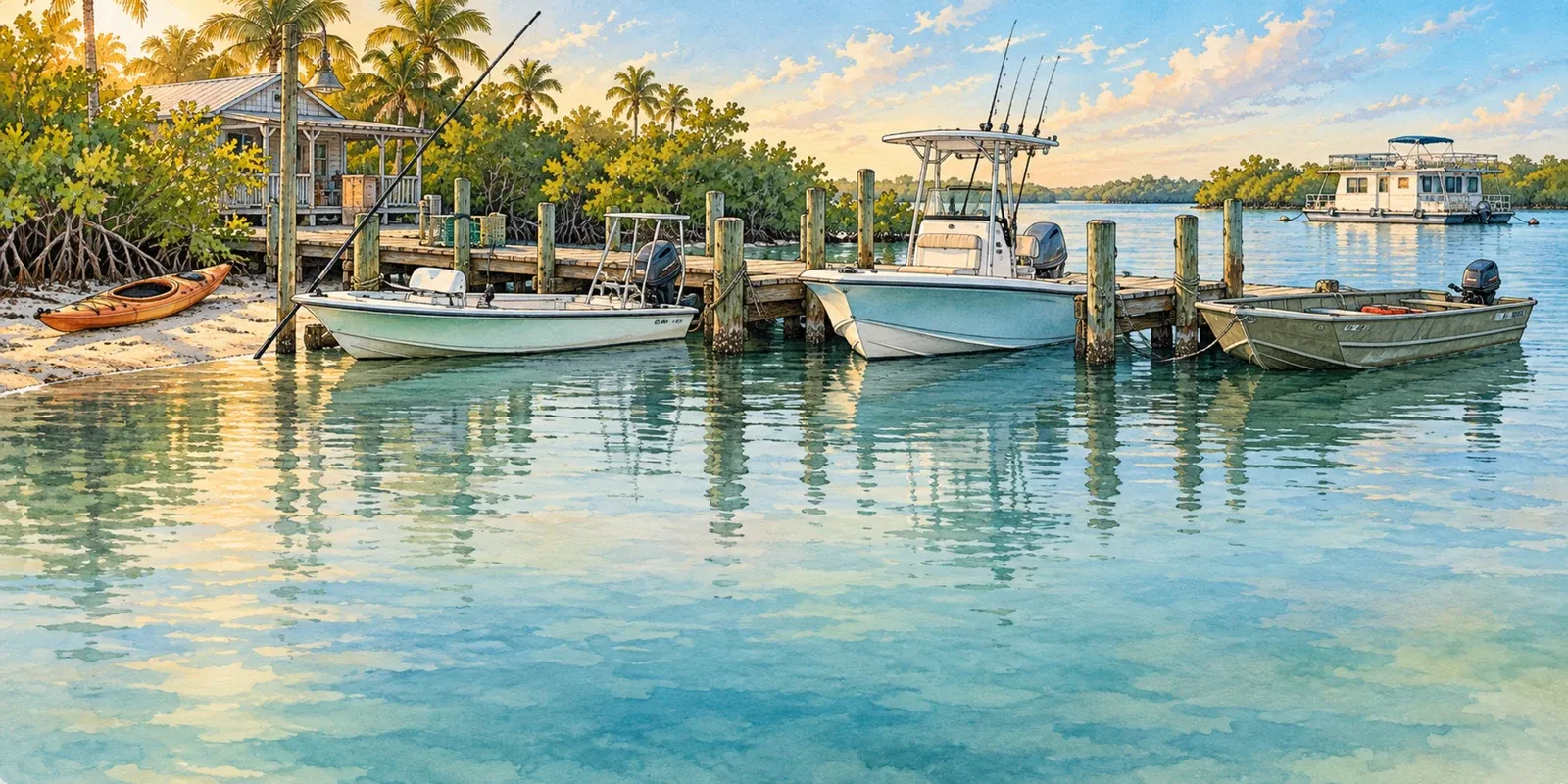
Hulls: what kind of boat
-
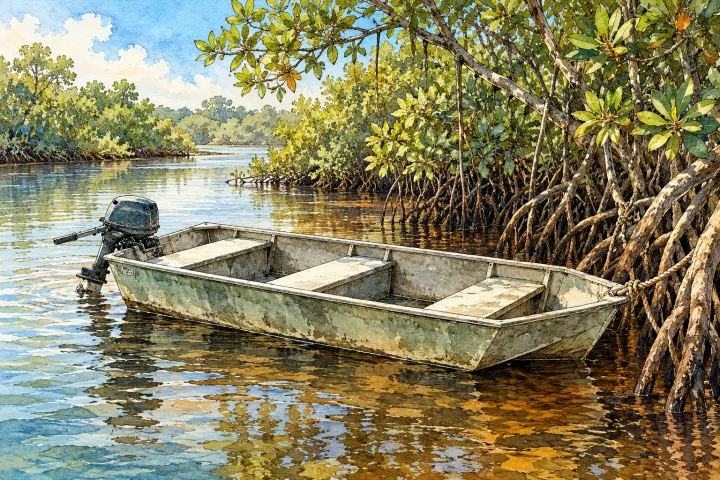
Jon boat (flat-bottom)
A flat-bottomed aluminum boat, usually 10 to 16 feet, with bench seats and a small outboard on the back steered by a tiller.
Why guides use it. It floats in a few inches of water, sits steady while you stand and cast, and costs less than almost anything else with a motor. Thousands of Florida kids learned to fish from one.
Watch out. The flat bottom slaps and pounds in chop, so it belongs in creeks, canals and calm bays, not open water on a windy day.
Draft 4–8 in · 10–16 ft · 5–25 hp tiller outboard
-
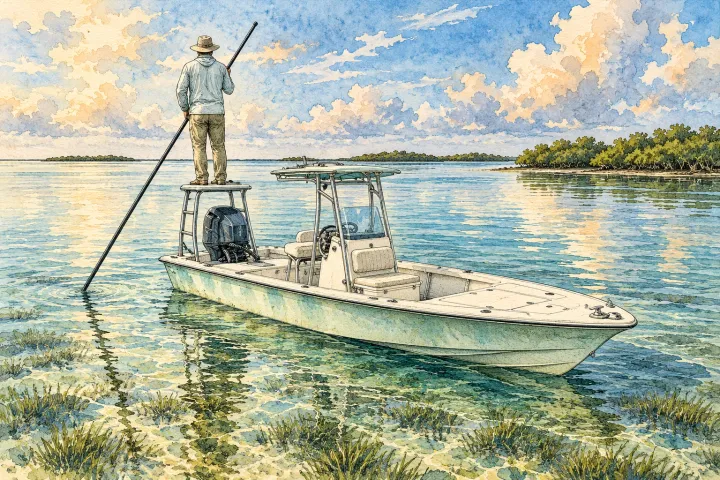
Flats skiff (technical poling skiff)
A light, low 16- to 18-foot boat built to float in six to ten inches of water, with a raised platform at the stern where the guide stands and pushes the boat along with a pole.
Why guides use it. Shallow water is where redfish, snook and bonefish feed, and a motor would spook them. A skiff glides in silently, the guide sees the fish from the platform, and the angler casts from the bow.
Watch out. Wet and bouncy in a chop, little room for gear, and the push pole takes practice. A tunnel hull lets the prop sit higher for even shallower running.
Draft 6–10 in · 16–18 ft · 40–90 hp · poling platform, push pole, bow casting deck
In the book: The Bonefisher
-
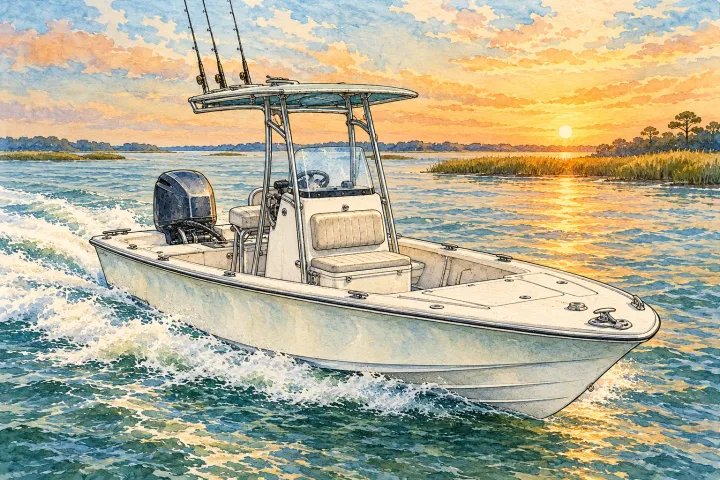
Bay boat (center console)
An 18- to 24-foot boat with a modified-V hull and the steering console in the middle, so you can walk all the way around it while fighting a fish.
Why guides use it. It is the all-rounder of the Ten Thousand Islands: shallow enough for most backcountry bays, deep enough to cross open water to the outside keys, and roomy enough for four anglers and a cooler.
Watch out. It drafts more than a skiff, so the deepest backcountry is off limits, and a hard chop still gets wet. Most guides run one; Dan's Mako is this kind of boat.
Draft 12–16 in · 18–24 ft · 90–250 hp · center console, T-top optional, live well
In the book: The Mako
-
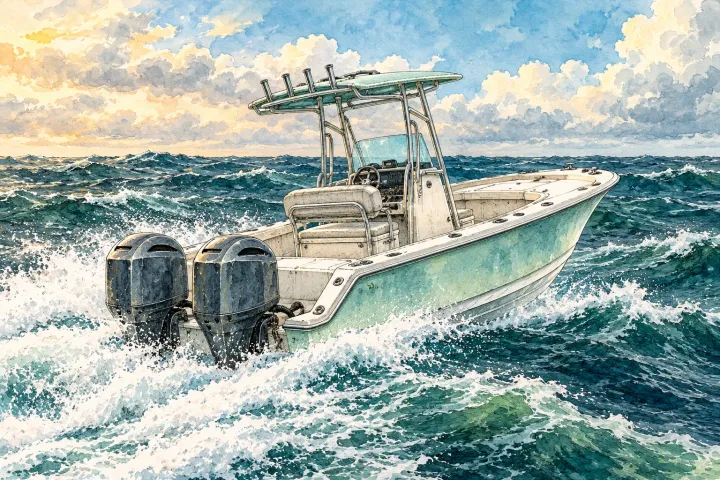
Deep-V offshore boat
A boat with a sharply angled bottom that slices through waves instead of slapping them, usually 20 feet and up, built for the open Gulf.
Why guides use it. When the wind is up and the water is big, the deep-V keeps running. Captain Homer's twenty-one-footer is the sort of boat that takes a crowd out past the islands.
Watch out. Draft: a deep-V needs two feet of water or more and will plough into an oyster bar that a skiff slides over. Fuel use is high.
Draft 18–30 in · 20–30 ft · 150–400 hp · twin engines common
In the book: 'The Marina'
-
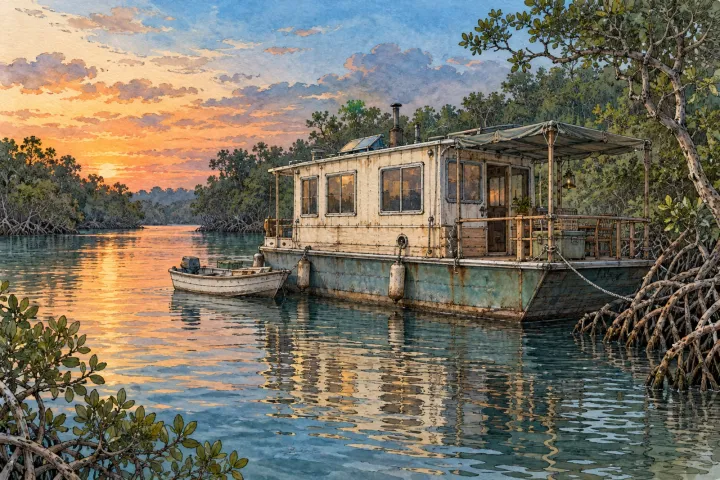
Houseboat
A floating cabin on a wide, flat barge or pontoon hull, with bunks, a galley and a deck, pushed along by an outboard or a small inboard at walking pace.
Why guides use it. It turns a fishing trip into a week on the water. You anchor in a lee, fish from the deck, sleep on board and move camp with the tide. The Sea Belle is Matt and Snapper's home at Lostman's River.
Watch out. Slow (five to eight knots), clumsy in wind, and heavy; when it grounds on an oyster bar at a falling tide you wait for the water to come back, which is exactly what happens in Chapter 12.
Draft 1.5–3 ft · 30–50 ft · 40–115 hp · cabin, galley, bunks, covered deck
In the book: The Sea Belle
-
Airboat
A flat-bottomed boat driven by an aircraft-style propeller in a cage at the stern, steered by rudders in the prop wash. Nothing hangs below the hull.
Why guides use it. With no propeller or rudder in the water, an airboat runs on inches of water, wet grass and even mud, which is how Everglades hunters, rangers and guides reach the sawgrass country nothing else can. Dad's red airboat is the one in the garage.
Watch out. Loud enough to need ear protection, no brakes and no reverse, and it slides in turns. Florida requires boater education for operators and a special course for commercial airboat guides.
Draft 2–4 in on plane · 12–18 ft · 350–500 hp car or aircraft engine · cage propeller, twin rudders
In the book: Dad's red airboat
-
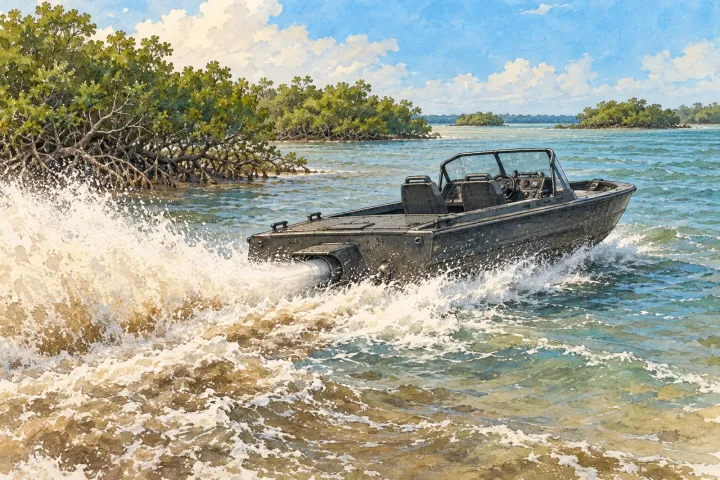
Jet boat (jet drive)
A boat pushed by a pump that sucks water in through a grate on the bottom and shoots it out the back, instead of a propeller.
Why guides use it. Fast, and with no prop to hit a rock or a swimmer. In rivers with gravel and rock it is the safe choice.
Watch out. The pump needs clean water to drink. In soft mud and silt it sucks in bottom, loses thrust and bogs down, which is why the smugglers' jet boat stalls three times chasing the Mako into one-foot bays. Steering also fades at idle.
Draft 8–12 in moving, more at rest · 14–24 ft · 90–300 hp · jet pump instead of a lower unit
In the book: The smugglers' jet boat
-
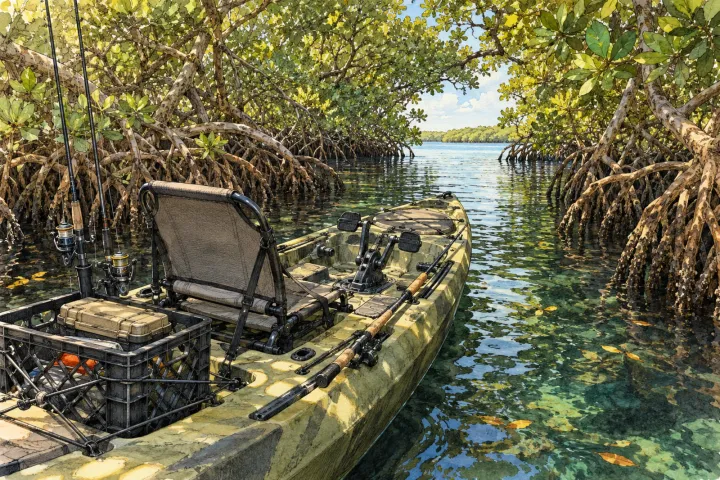
Fishing kayak
A wide, stable sit-on-top kayak, 10 to 14 feet, built to be fished from: a flat deck you can stand on, molded rod holders, a seat up off the water, and a hatch or tank well behind you for a crate. Three ways to move it: a paddle, a pedal drive that turns a propeller or fins, or a small electric motor.
Why guides use it. Silent, cheap to run, and able to slide into mangrove tunnels and over flats no powerboat can reach. The Wilderness Waterway through the Ten Thousand Islands is a famous paddle route, and plenty of snook and redfish are caught from a kayak at the mangrove edge. Pedal drives leave both hands free for the rod.
Watch out. Tide and wind set the day: plan to go out on the ebb and come home on the flood, or the other way around, never against both. Carry water, a chart, a whistle, a light, and leave a float plan. Stay out of the main channels where powerboats run.
Draft 3–5 in · 10–14 ft · 30–36 in wide · paddle, pedal drive, or 1–3 hp electric · 350–500 lb capacity
-
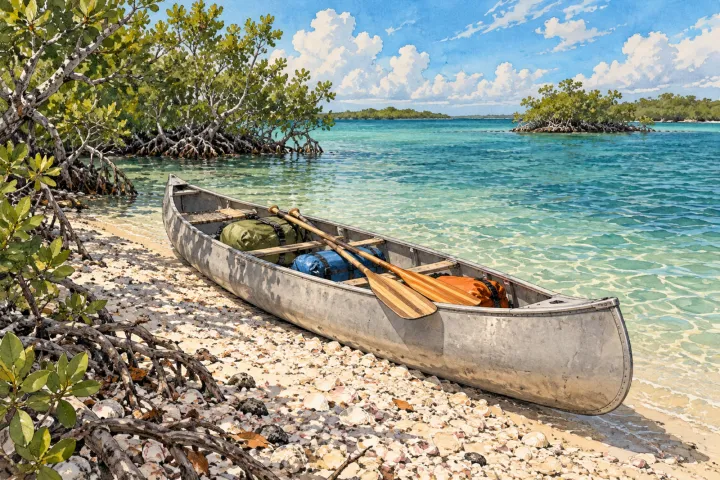
Canoe
The original Everglades boat: 15 to 17 feet, two paddlers, gear in the middle. Rangers and old-timers still cover the backcountry this way.
Why guides use it. Carries a week of camping gear, floats in inches, and costs nothing to run. Quiet enough to drift up on tailing redfish.
Watch out. Tippy when you stand; a crosswind on open bay is hard work. Kneel in chop and keep the load low.
Draft 3–5 in · 15–17 ft · two paddlers · 700–900 lb capacity
Power: what moves it
-
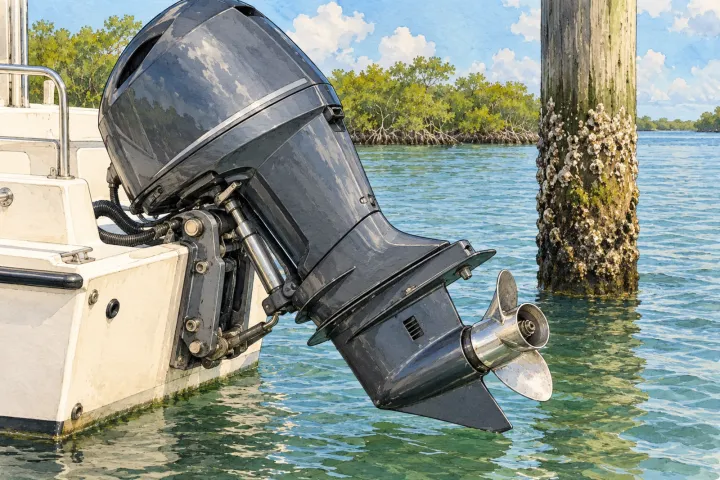
Outboard motor
The engine that hangs on the back of almost every boat in the islands, from a 5-horsepower tiller on a jon boat to a 250-horsepower console-steered engine on a bay boat.
Why guides use it. Simple to service, easy to tilt up over oyster bars, and the whole drive comes out of the water at the dock. Four-strokes are quiet and sip fuel; older two-strokes are lighter and louder.
Watch out. The lower unit and propeller are the first things to hit bottom. A jack plate lifts the engine to run shallower; a kill-switch lanyard clipped to the driver stops the engine if they go overboard.
5–300 hp · tiller or console steering · four-stroke standard today
In the book: The Mako , The Bonefisher , Doc's skiff
-
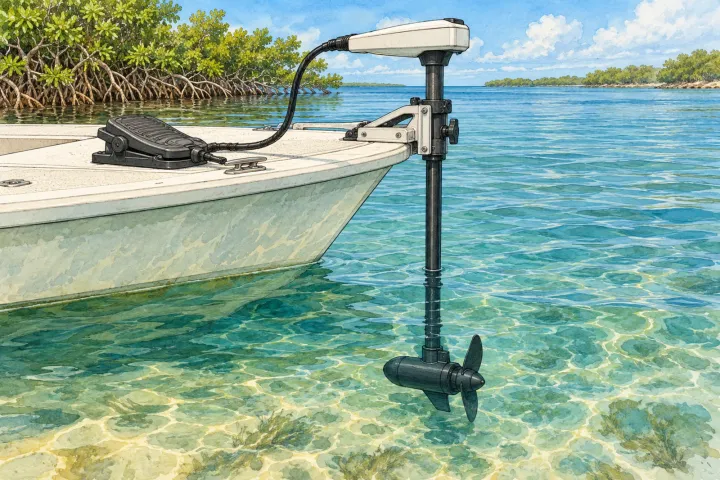
Trolling motor
A small electric motor on the bow, controlled by a foot pedal or a remote, used to creep along a shoreline without starting the outboard.
Why guides use it. It moves the boat at fish-stalking speed and stays quiet. Newer ones have GPS that holds the boat in one spot against wind and current, an electric anchor.
Watch out. Batteries run down; the prop fouls in grass; and in the Everglades a push pole is still quieter.
12–36 volt · 55–112 lb thrust · bow mount · GPS anchor on newer models
-
Push pole
An 18- to 24-foot pole, usually graphite or fiberglass, with a forked foot that grips mud and a point for hard bottom, used from the stern platform to move a skiff silently.
Why guides use it. Zero noise, zero wake. Snapper poles the Mako into the mangroves at Pavilion Key so the smugglers never hear a motor.
Watch out. It takes shoulders and practice: push, recover, steer by planting the foot behind the boat. Don't pole with the point into soft mud.
18–24 ft · graphite or fiberglass · forked foot and pointed tip
In the book: The Mako
-
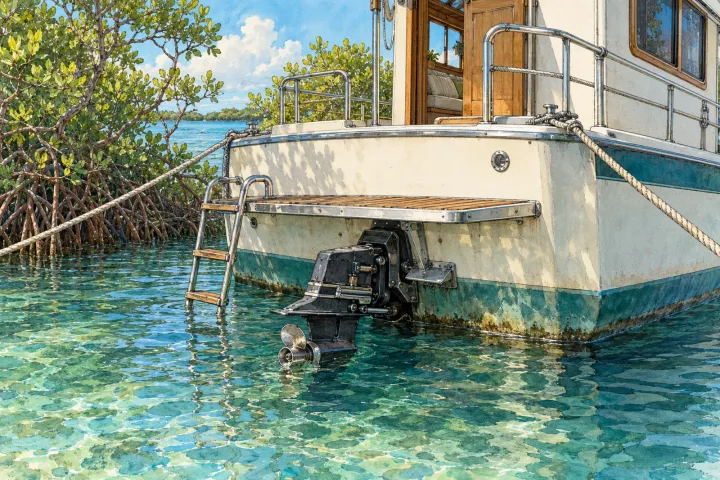
Inboard and sterndrive
An engine mounted inside the hull, driving a propeller through a shaft (inboard) or through a drive unit on the transom that tilts like an outboard (sterndrive).
Why guides use it. Common on bigger boats and houseboats: more power low in the hull, quieter inside the cabin, and the engine stays dry.
Watch out. A true inboard's prop and rudder cannot be raised, so it needs deeper water; service means opening the deck.
Houseboats, cruisers and larger offshore boats
In the book: The Sea Belle
Gear and words
-
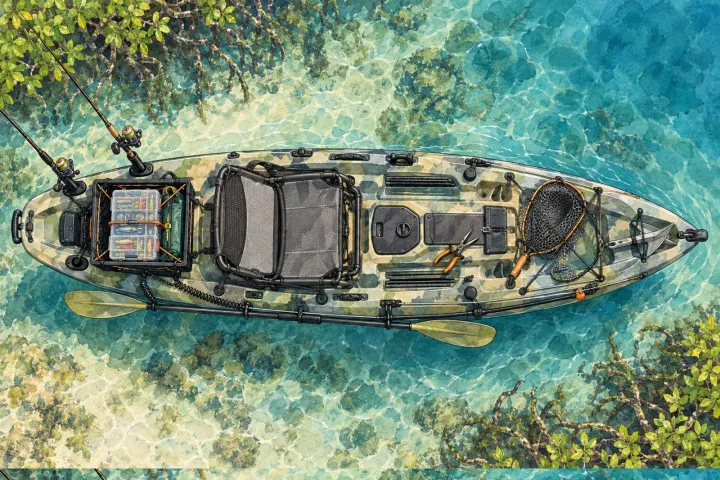
How a fishing kayak is rigged
The basics on almost every Everglades fishing kayak: a comfortable raised seat; two or three rod holders (flush-mounted behind the seat, one adjustable up front); a paddle leash so the paddle can’t float off; an anchor trolley, a line that runs the length of the hull so the anchor or stake-out pole can be set from bow or stern; a small crate or tackle bag in the tank well; a landing net; pliers on a lanyard; a fish grip; and a measuring board.
Why guides use it. A kayak has no room to move, so everything is within reach of the seat. The anchor trolley is the trick most beginners miss: it lets you point the bow into the wind and fish facing the mangroves without paddling to stay put.
Watch out. Wear the life jacket, not just carry it; the Coast Guard requires one aboard and Florida requires kids under six to wear one. A whistle is required, a white light after dark. A fish finder is nice but a paper chart in a bag matters more out here.
Seat · 2–3 rod holders · paddle leash · anchor trolley with stake-out pole or 1.5 lb anchor · crate or tackle bag · net · pliers · fish grip · measuring board · PFD · whistle · light · dry bag · chart
-
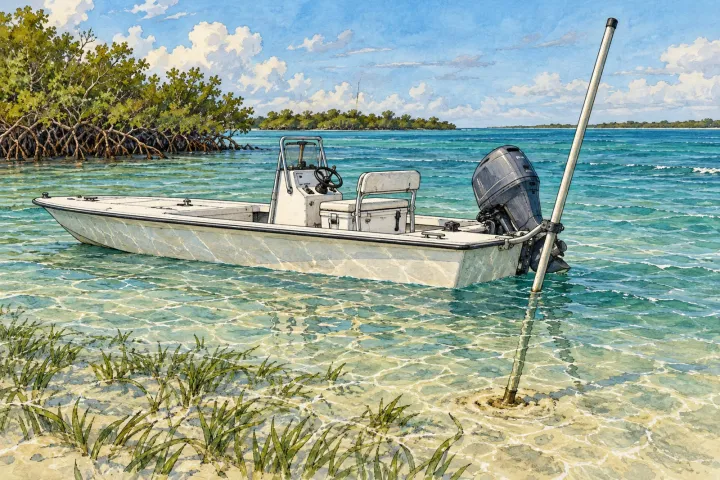
Shallow-water anchors and stakes
A pole that drives into the bottom to hold the boat still: a stake-out pole pushed in by hand, or a hydraulic one on the transom that drops at the push of a button.
Why guides use it. Holding position quietly on a flat beats dragging an anchor and chain. At Comer Key the sand pipes do the same job for the rods.
Watch out. Only in soft bottom and shallow water; don't stake out in a channel with boat traffic.
6–10 ft stake-out pole · 4–10 ft hydraulic transom anchors
-
What every boat carries
Life jackets for everyone aboard, a throwable cushion, a fire extinguisher, a sound signal, lights for night, a VHF radio on channel 16, an anchor, a bailer, a chart, and a float plan left with someone ashore.
Why guides use it. The Ten Thousand Islands look alike, cell service fades past the causeway, and a falling tide can strand a boat for six hours. Dan's rule in the book is channel sixteen, nine to ten p.m.
Watch out. Florida requires anyone born on or after January 1, 1988 to carry a boater education card to run a boat of 10 hp or more. Kids under six must wear a life jacket on boats under 26 feet while underway.
PFDs · throwable · extinguisher · horn or whistle · nav lights · VHF · anchor · bailer · chart · float plan
In the book: The Sea Belle , The Mako
-
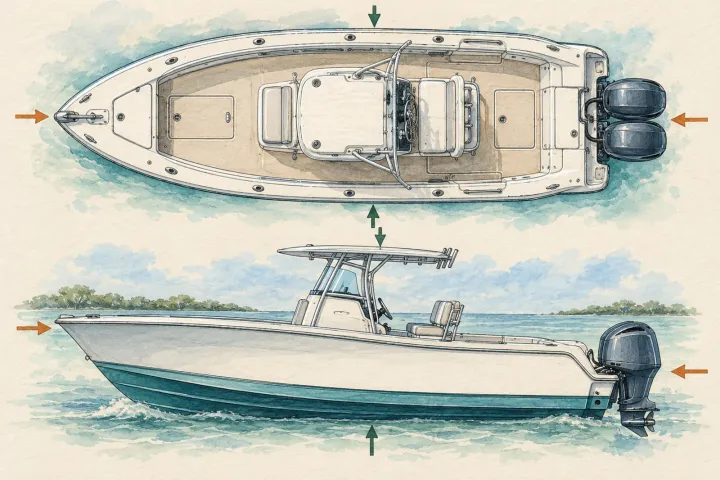
Boat words worth knowing
Bow (front), stern (back), port (left), starboard (right). Draft: how deep the boat sits. Deadrise: how V-shaped the bottom is. Chine: the edge where bottom meets side. Transom: the flat back where the motor hangs. Gunwale: the top edge of the side. Deck, console, live well, bilge.
Why guides use it. Matt checks starboard in the Guidebook on his first flight; the twins already know it. A crew that shares words moves faster when a fish is on.
Watch out. Port and left both have four letters. That is the trick.
In the book: Boeing 737
General guidance, not a safety course. Florida’s boating rules change; check the FWC boating pages before you run a boat, and take the free boater education course if you were born in 1988 or later. Companion-site illustration (AI-generated from the author’s brief) for the pictures.