Lesson 7 of 10 · Stopping on purpose
Anchoring and docking
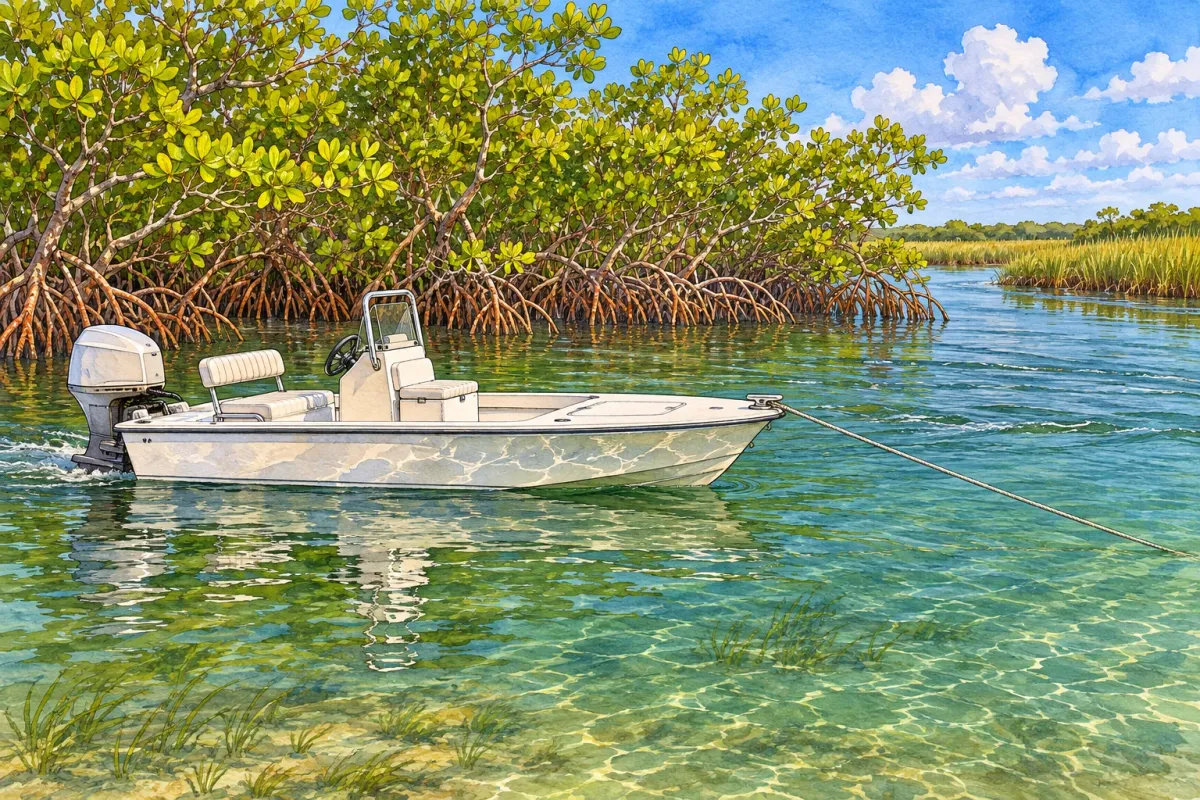
Anyone can make a boat go. Crew earn their keep by making it stop, exactly where the captain wants it.
Lesson 7 comes with the Experience
Lessons 1 and 2 are free. The other eight, Rig It Right, the whole book to read and hear, and all 23 missions come with the Summer Fishing Guide Experience.
- Anchor from the bow A small boat held by its stern alone can be swamped by the current or a wave. A stern anchor only ever goes out with a bow line, like the storm tie-off.
- Let out plenty of line Five to seven feet of line for every foot of depth. An anchor holds by lying down and digging in, not by hanging.
- Point into it Come up into the wind or the current, whichever is stronger, stop, lower the anchor and drift back on it. Never throw it.
- Dock slow Approach a dock no faster than you’d be willing to hit it. Into the wind or current gives you the most control.
- Lines ready first Dock lines on the cleats and fenders over the side before you get there. Hands and feet stay inside: never fend off a dock with your body.
- The cleat hitch Once around the base, a figure eight over the horns, and one locking turn. It holds all night and comes off in a second.
Guide’s rule
Never come at a dock faster than you’re willing to hit it.
In the book: The storm tie-off in Chapter 12: a bow line to one mangrove and a stern anchor out, so the boat is stretched secure from end to end.
Three questions
1. Which end of the boat does the anchor line tie to?
The bow. A boat held by the stern alone can be swamped.
2. In 6 feet of water, about how much anchor line?
Five to seven times the depth, so the anchor lies flat and digs in.
3. The best speed for coming in to a dock is…
Slow is a small mistake. Fast is a big one.
Lesson passed.